Section
Garden Decor, Bird Feeders and Bulbs
This is the Garden & Birds section: bird feeders and seed, hummingbird feeders, bird houses and baths, wind chimes and garden decor, flower bulbs, hand tools, hoses, wheelbarrows and rain barrels. Each page sorts real Amazon US listings by what the maker states, like the seed a feeder takes, the tube length of a chime or the bloom season on a bag of bulbs. I'm Ana Pruitt. I keep a feeder log on the porch, and I read the label before I plant anything.
What’s in this section
Best-of lists
Best Bird Feeder Cameras
Camera bird feeders whose listing states the video resolution, highest resolution first, at most two per brand. Subscription terms and power source are shown for each as the maker states them.
Best Heated Bird Baths
Bird baths whose maker or listing states a built-in heater, lowest listed wattage first. A thermostat and an electrical listing (UL, ETL, CSA) are shown only where the maker states them.
Brands in this section
What's in the garden decor and birds section
This section covers the part of a yard you look at from the porch. It's grouped the way you'd shop: the birds first, then the things that make noise and catch the light, then the bulbs and tools and hoses that keep it going. Each group below links to its pages, and the cards above show every type page that's open now.
Every page in Garden & Birds follows the same rule. A spec in a table comes from the maker or the listing. If neither says it, the cell shows a dash. Nobody here claims to have hung, filled or planted the products listed. The opinions are about kinds of things, like where to put a feeder pole, and each one comes with a reason you can check.
Birds and feeders
Feeding birds is a habit, not a purchase. The feeder is the cheap part. The seed, the cleaning and the spot you choose are where the years go.
- Bird feeders: tube, hopper, platform and window styles, sorted by what the listing says each one holds
- Bird seed: the seed decides who comes to dinner more than the feeder does
- Suet feeders: cages for suet cakes, a fat-based bird food
- "Squirrel-proof" bird feeders: feeders whose listing makes that claim, with weight-activated perches, cages or baffles
- Hummingbird feeders: sugar-water feeders sorted by port count and capacity from the listing
- Heated bird baths and the list of best heated bird baths: open water in a freeze
- Bird feeder cameras and the best bird feeder cameras: feeders with a camera built in or mounted on
Here's the one opinion on this page. "Squirrel-proof" is a listing claim, not a law of nature. A baffle and where you put the pole do more than the word on the box. Baffle makers print the spacing they want from roofs, fences, branches and the ground. Follow it, and almost any feeder does better. Ignore it, and even a caged feeder becomes a puzzle box with a prize inside.
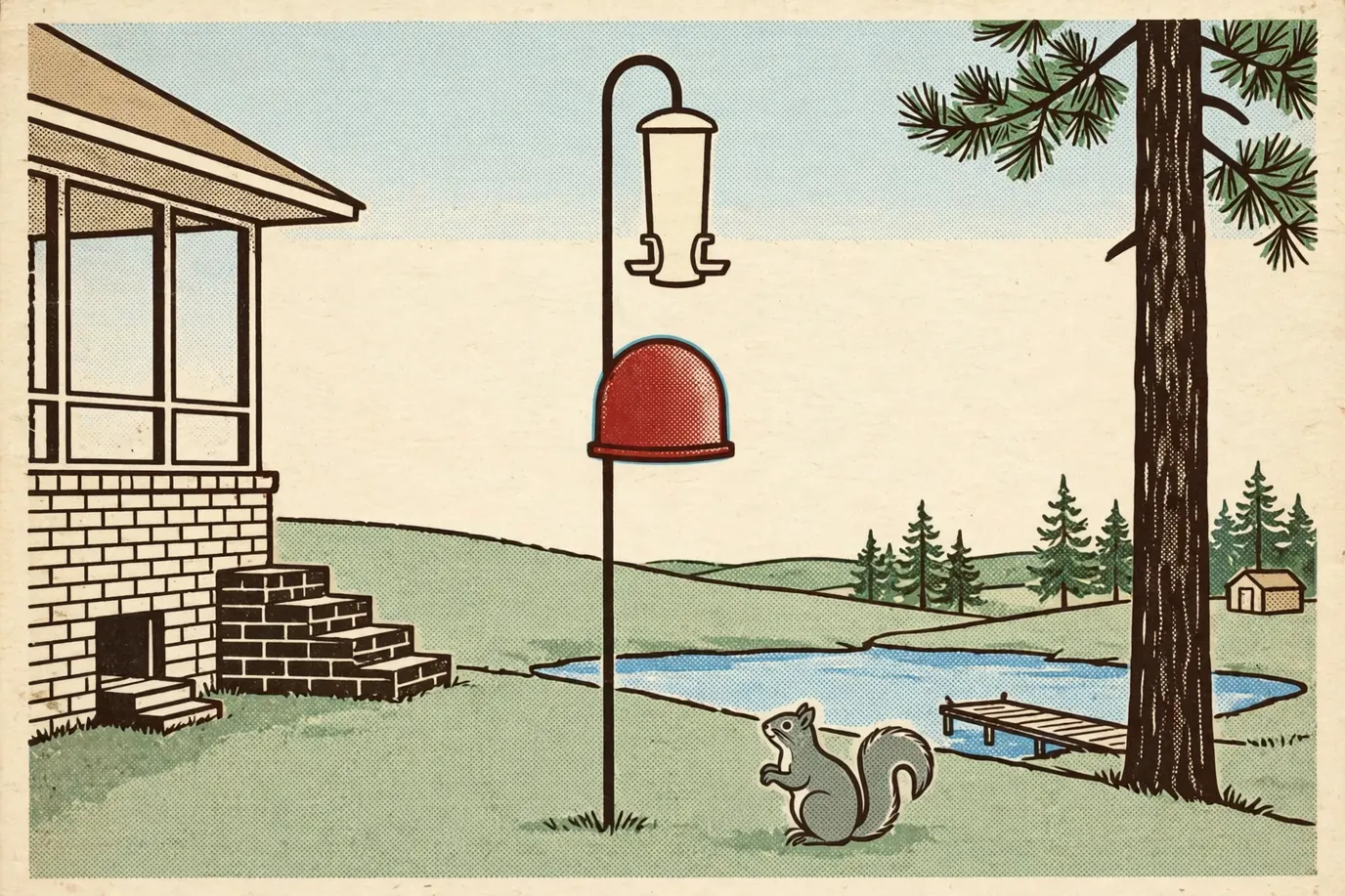
The Admiral and the pole that moved
I'll tell you how I learned that. A gray squirrel I call the Admiral has beaten two pole baffles at the feeder by our porch steps. He didn't climb past them. He didn't have to. He jumped from the porch roof and skipped the pole altogether.
So I read the baffle maker's spacing instructions, all of them, and moved the pole out into the lawn, away from the roof edge. Then I logged the first squirrel-free week in my feeder notebook, with the date underlined twice.
The Admiral now forages on the grass under the feeder for whatever the other birds drop. I respect him. I don't feed him on purpose. And I've stopped believing any feeder's name before I've checked its placement.
Ken's take, when he saw the new spot: "A feeder pole is a fence post with a job. Set it plumb, set it deep, and keep it away from anything a squirrel can launch from." He's a finish carpenter. Everything is a fence post to him eventually.
Clean feeders and baths on a schedule
Dirty feeders and old water can spread disease among birds. Clemson's Home & Garden Information Center says to clean seed feeders at least every two weeks, more often after rain or heavy use, and to refresh hummingbird sugar water about twice a week, more in hot weather. The Iowa Department of Natural Resources adds a weekly scrub and fresh water for bird baths. Both say to dry feeders fully before you refill them, and to sweep up spilled seed underneath.
Wear gloves when you clean, and wash your hands after. If you see sick birds at your feeder, take it down and tell your state wildlife agency.
If your state wildlife agency asks people to take down feeders or baths during a disease outbreak, follow that advice.
Wind chimes and garden decor
Garden decor is the big, loose category: wind chimes, statues, gazing balls, wind spinners, weathervanes and metal or terracotta yard art. It's also the part of the section that sells to people who don't garden at all. That's fine. A porch can be a garden of one.
- Wind chimes: sorted by tube count and length where the listing gives them, because size decides how loud and how low a chime sounds
- Memorial wind chimes: chimes made for remembrance, on a quiet page of their own
Before you buy a long chime, it's fair to ask whose window it will face. On a small lot, a deep chime gets heard next door too.
Chimes are also one of the most common garden gifts, especially around Mother's Day. A chime makes a fair gift for someone with a porch and patient neighbors. For a wider spread, see gifts for gardeners and outdoor gifts.
Patio decor and backyard decor sit in this group too: solar pieces, terracotta pots and sculptures, metal yard art. Pick decor for the view you actually have. A gazing ball where nobody walks is a very shiny secret.
Flower bulbs
Fall is bulb time, and this group is the busiest part of the section from September to December.
- Tulip bulbs: bloom season and height only as the seller lists them
- Spring bulbs: tulips, daffodils, crocus, hyacinths and alliums, planted in fall
- Amaryllis bulbs and waxed amaryllis bulbs: indoor winter bloomers, often sold as gifts
- Paperwhite bulbs: forced indoors in a pot or a bowl of pebbles
Fall bulb planting starts when the soil cools, not when the store rack fills up. NC State Extension's rule is to plant spring-flowering bulbs once the soil drops below 60°F. Iowa State University Extension says they can go in as late as December if the ground isn't frozen. The guides to when to plant tulip bulbs, how to plant tulip bulbs and how to care for amaryllis cover the details.
Tulip, daffodil, hyacinth and amaryllis bulbs are toxic to dogs and cats. Store and plant them where pets can't dig them up.
Garden tools, hoses and watering
The working end of the section. These pages open through the year, so some are still in the queue.
- Hand tools and pruners: trowels, hand cultivators, bulb planters, pruning shears, loppers, rakes and hoes. Blade type, cutting capacity and handle length come from the maker.
- Hoses and reels: garden hoses by length and material, hose nozzles, hose reels and timers. Length and diameter are the specs that decide whether a hose reaches the far bed and how much water it carries.
- Watering: watering cans, sprinklers, soaker hoses and drip kits.
If you're starting from nothing, you don't need the whole aisle. A trowel, a pair of bypass pruners, a hose long enough to reach the far bed and a watering can will carry most small yards through a first year. Add a hand cultivator when the weeds introduce themselves, and a bulb planter if fall is your planting season. Everything else can wait until you know what you actually do out there.
Field note: a hose that's 10 feet short of the far bed will spend its whole life being stretched. Measure from the spigot along the path you'll walk, not across the lawn as the bird flies.
Wheelbarrows, carts and rain barrels
Two groups that save your back and your water bill.
- Wheelbarrows and garden carts: one wheel or two, steel or plastic tub, air-filled or flat-free tires. A pneumatic tire is air-filled and rides softer. A flat-free tire is solid and never needs a pump. Pick by what you haul and how often.
- Rain barrels: barrels, stands and downspout diverters. A diverter is a downspout fitting that sends rainwater into the barrel and lets the rest run past when it's full. Capacity and whether a barrel has an overflow port come from the listing.
How to read a garden listing
A few things I check on every garden listing before it gets near a table.
- The plain facts. Capacity, port count, tube length, bulb size, hose length. If a listing doesn't give them, our table shows a dash.
- The claim words. "Squirrel-proof," "weatherproof," "deer resistant" and "rust-proof" appear on our pages only when the maker says it about that exact model. We don't add them.
- The zone or season. For bulbs and plants, the seller's zone range and bloom season. Then check your own zone on the USDA map by ZIP code.
- The cleaning. For anything that holds seed, nectar or water, how it comes apart. A feeder you can't take apart is a feeder you won't clean.
That last one matters more than any color or shape. Look it up, then hang it.
Related
Guides
Questions people ask
How do I attract birds to my yard?
Give them food, water and cover. Mississippi State University Extension lists all three: a feeder or two, a clean bird bath kept full, and a mix of trees, shrubs, ground cover and open lawn. A heated bird bath keeps water open in winter. Then match the seed to the birds you already see, and clean feeders and baths on a schedule.
What makes a bird friendly garden?
Layers and water. Mississippi State University Extension points to plants of different heights, from ground cover to trees, because they give shelter and natural food such as berries, seeds and insects. Add a bath, a few bird houses for the species that nest in them, and feeders placed where you can see them and clean them.
When is fall bulb planting time?
When the soil cools. NC State Extension's rule of thumb is to plant spring-flowering bulbs once the soil has dropped below 60°F, which in central North Carolina usually means November. Iowa State University Extension says bulbs can go in as late as December if the ground isn't frozen. Our guide to when to plant tulip bulbs walks through it by area.
How do I prepare my garden for winter?
Clean and store what freezes: drain hoses and bring them in, empty and turn over a rain barrel or disconnect it, and put hand tools away dry. Get fall bulbs in before the ground freezes and mulch them. Keep feeders full and switch to a heated bird bath if water freezes where you live. Your county extension office publishes a local calendar for the rest.
Is there a gardening calendar for my area?
Yes, and it's local. County extension offices publish planting and garden-chore calendars for their own area, and the USDA Plant Hardiness Zone Map tells you your zone by ZIP code. Use both. A calendar written for a cold state will have you planting a month early in the South.
Sources
- Mississippi State University Extension: How to Attract More Birds to Your Yard — accessed 2026-10-24
- Clemson Cooperative Extension, Home & Garden Information Center: Washing Bird Feeders — accessed 2026-10-24
- Iowa Department of Natural Resources: Plan regular cleanings of bird feeders, waterers and baths (Apr 22, 2025) — accessed 2026-10-24
- NC State Extension, Wayne County Center: Plant Bulbs This Fall for Spring Flowers (Oct 30, 2025) — accessed 2026-10-24
- Iowa State University Extension: Can I plant tulip bulbs in November or should I wait for spring? — accessed 2026-10-24
- USDA Plant Hardiness Zone Map — accessed 2026-10-24