Best humidifier picks, by tank size
The table sorts every pick by the stated tank, biggest first. That puts three rough groups on one list, and they're for different houses.
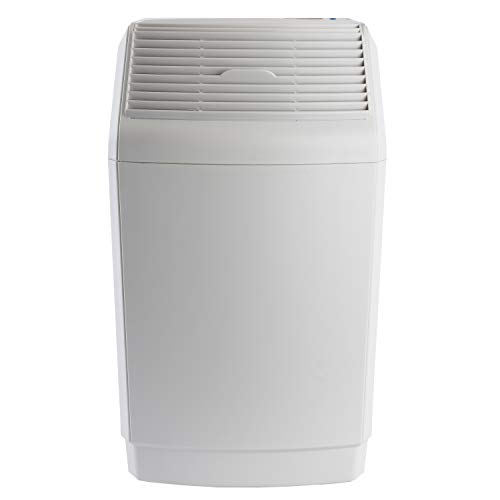
Whole-floor units, 6 gallons and up. The Lacidoll and the two AIRCARE Space Saver units at the top, plus the LEVOIT Superior 6000S, hold 6 to 6.8 gallons. The listings give coverage from 2,300 to 3,000 square feet where they state it. These are for an open floor plan, a big great room or a house where one machine has to do the work of three. Three of the four are evaporative. The Lacidoll at the very top is ultrasonic.
Large-room units, 4 to 5.3 gallons. The Turbro, the second Lacidoll and the Vornado Evap40 sit here. Listed coverage runs from 1,000 to 2,000 square feet. This is the size for a living room with an open kitchen, or a basement family room in January.
Room units, under 3 gallons. The LEVOIT OasisMist 1000S, the Hunter HHU400 and the two steam units from Honeywell and Vicks. These are for one room, usually a bedroom. The two steam units hold 1.5 gallons each and boil water to make vapor.
Every number above is what the maker or the Amazon listing states. Where a listing doesn't give a figure, the table shows a dash, and I don't guess.
One more thing about the groups. Bigger isn't better if the room is small. A whole-floor unit in a 12-by-12 bedroom will push the humidity past where you want it, and then it shuts off and starts again all night. Match the group to the space first, then pick inside the group.
How to choose the best humidifier for winter
Winter is when most people shop for one. Heating dries the air, the static shocks start, and the wood floors begin to tick at night. Five things decide which humidifier fits your house. I'll take them in the order I'd check them.
Type comes first: ultrasonic, evaporative or steam
There are three types on this list. They make moisture three different ways, and that changes what comes out of them.
- Ultrasonic: a plate vibrates fast enough to throw the water into a fine, cool mist
- Evaporative: a fan blows air through a wet wick filter; you don't see mist
- Steam (vaporizer): a heater boils water and the steam rises out
The EPA's page on home humidifiers says ultrasonic and impeller units appear to disperse the most microorganisms and minerals into the air. It also says steam and evaporative units aren't expected to disperse substantial amounts of minerals. That's the main trade between them.
Ultrasonic units are usually quieter at the fan, since many don't have one. Evaporative units need wick filters replaced. Steam units boil water, and the EPA warns that steam and boiling water may cause burns, so keep them out of children's reach.
Here's my one opinion on this page. If you're on hard water or a well, as we are, and you want one unit for a whole floor, I'd look at an evaporative unit first. The reason is the EPA's mineral point above, not anything about a brand. A wick filter is a sponge with a job description, and the job is to keep the minerals in the machine instead of on your furniture.
Tank size decides how often you refill
Tank size is the one number every pick on this list states, so it's the sort order. A bigger tank means fewer trips to the sink. It also means more weight to carry when it's full, and a full 6-gallon tank is a real lift.
Check whether the unit fills from the top. Several listings here say top fill, which means you can pour water in from a pitcher without carrying the tank. On a big unit, that matters more than any other convenience.
Ken's take, when he saw the 6.8-gallon number: "A tank you have to carry to the tub is a tank you'll fill on Saturdays." He measures everything. He measured that, too.
Coverage is the maker's number, not your house's
Coverage in square feet is what the maker or listing claims the unit can serve. It's a useful way to compare one unit with another. It's not a promise for your rooms.
Your house has ceilings, stairwells, drafty windows and doors that open to let the dog out every twenty minutes. A big open floor with cathedral ceilings asks more of a humidifier than the same square footage in closed-off rooms. If you're between two sizes, the bigger tank costs you nothing but weight.
Some listings on this page don't state coverage at all. The LEVOIT Superior 6000S, the Honeywell and the Vicks are the three without it. That doesn't make them small, it makes them harder to compare.
A humidistat and auto shut-off keep it honest
A humidistat is a built-in sensor that turns the humidifier off when the room reaches the level you set. Without one, the machine runs until the tank is empty, whether the room needs it or not. Auto shut-off turns the unit off when the tank runs dry.
The EPA recommends keeping indoor humidity at or below 50 percent. MedlinePlus, from the U.S. National Library of Medicine, says to keep it between 40 and 50 percent. Both point to the same sign that you've gone too far: water on the windows. A unit with a humidistat makes that easier. A cheap humidity gauge on a shelf does too, and I'd buy one either way. Our guide on the ideal indoor humidity covers how to read it.
Noise, if the listing gives it
Few picks on this list state a noise level; the two Lacidoll units list 35 dB. For scale, the CDC's NIOSH noise chart puts a whisper at 30 dB and normal conversation at 60 dB. Makers don't always say how far away they measured, so treat any dB number as a comparison tool. If noise is your main concern, the humidifiers for bedrooms list sorts by stated noise level instead of tank size.
Water and cleaning are the real cost
Every humidifier holds standing water, and standing water grows things if you let it. That's the part of owning one that the box doesn't show.
The EPA's guidance for portable humidifiers is plain. Empty the tank, wipe it dry and refill with fresh water every day, unplugging the unit first. Clean it every third day, removing scale and film. If you use a cleaner or disinfectant, rinse the tank well.
On water, the EPA says distillation is the most effective way to remove minerals. It notes that bottled water labeled spring, artesian or mineral has not been demineralized. Some units take a demineralization cartridge. The EPA says to use those only if the maker supplies or recommends them, and to watch for white dust, which suggests minerals are getting through.
Read the plate first, then the manual. Use the water type the manual calls for and follow its cleaning steps for its own parts. If the manual and the EPA disagree on a detail, the manual knows that machine.
Ana's ruling on all this: a humidifier is a pet that drinks a gallon a day and never thanks you. She's not wrong. She also refills ours more than I do.
Is there a best humidifier for allergies?
Not on this page, and I'd be careful with anyone who says there is. A humidifier adds water to the air. That's all it does. None of the picks here is listed as treating allergies, and none is sorted by that.
The EPA notes that humidity above 50 percent can encourage biological growth in a home. That's why too much humidity can work against you. If allergies are why you're shopping, ask your doctor whether your house needs more humidity or less before you buy anything.
Who should skip this list
If your house already sits at 40 percent or above in winter, you don't need a humidifier. You need a gauge to confirm it. If your windows fog up on cold mornings now, adding moisture will make them worse.
If you live in a small apartment, the whole-floor units at the top are more machine than you need. Look at the room units at the bottom of the list, or at the bedroom list.
And if nobody in the house is going to clean it every few days, don't buy one yet. A dirty humidifier is worse than none. I've been in enough basements to know that a machine nobody looks after doesn't stay a small problem.
How we picked
This list takes every humidifier in our data whose maker or Amazon listing states both the tank size and the type: ultrasonic, evaporative or steam. Products are sorted largest tank first. We keep at most two per brand and five per type, so one maker or one type can't take over the list.
All specs come from the maker or the listing as of October 31, 2026. We don't test products, and we don't rank by star ratings. The list is checked again every week, so the order can change as listings change. Prices aren't shown on this site. The "Check price" button takes you to the current listing.
If you want to compare more models than these, the humidifiers page shows every humidifier in our data, smallest tank first. For the differences between mist types, see cool mist vs warm mist.
Pick the type you'll clean, size the tank to the room, and put a gauge on the shelf. Then fill it.