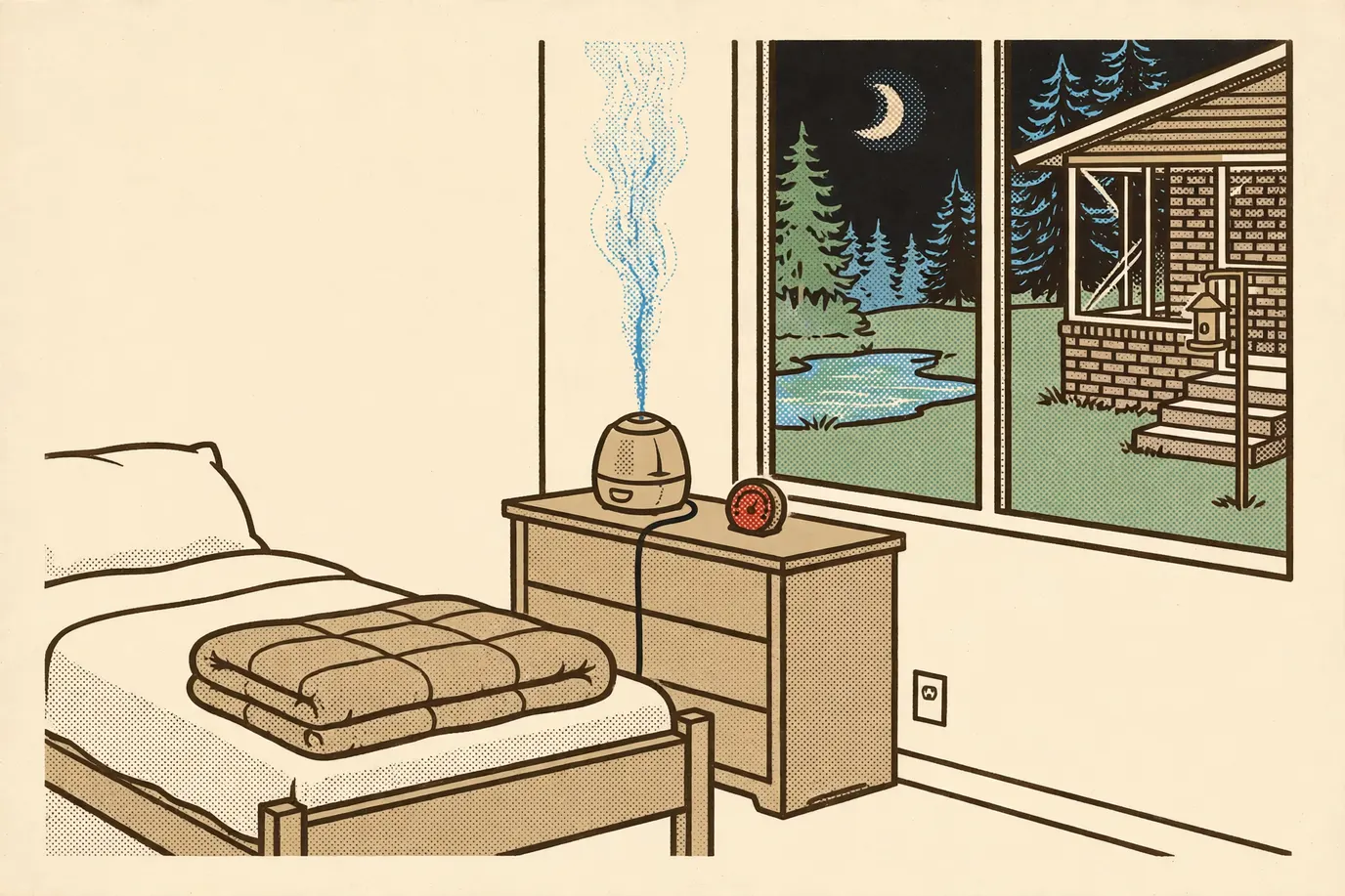
Bedroom humidifier picks, quietest stated first
Every pick on this list states a noise level in decibels. That's rarer than you'd think. Plenty of listings call a humidifier quiet without giving a number. Those don't make this list, because "quiet" with no number can't be compared with anything.
Here's how the stated levels fell when this was written:
- 19 to 21 dB: the LEVOIT evaporative model, both BLUEAIR DreamWell units and the DREO 747S
- 24 to 25 dB: the smaller GoveeLife and both BREEZOME units
- 26 dB: the DREO 11L, the larger GoveeLife and the LEVOIT 6L
Most of the quietest are evaporative or list a wick filter. That fits how they work: an evaporative unit is a small fan blowing through a wet wick, and a small fan turning slowly doesn't make much noise. The rest are cool-mist units, and the ones that state a technology say ultrasonic.
The stated tanks are bedroom-sized, from under a gallon to just under 3, and the listed coverage, where it's given, is a few hundred square feet. That's the right size for a bedroom. A whole-house unit in a bedroom is a firehose in a flower bed.
How to read a noise level in decibels
A decibel number is the maker's measurement, made the maker's way. It's useful for one thing: comparing two units that both state one. The CDC's NIOSH noise chart gives a sense of the scale. It puts a whisper at 30 dB and normal conversation at 60 dB. The picks here state levels below that whisper.
One thing to keep in mind: makers don't always say how far away they measured or at which setting. A quiet number is often for the lowest or sleep setting, so read the listing's wording and the manual before you count on it at the highest setting.
So a 19 dB unit and a 26 dB unit are both quiet by their makers' numbers. If one person in the room wakes when the refrigerator cycles, buy from the top of the list. If you both sleep through thunderstorms, the bottom of the list gives you more tank for the same space.
Ana's ruling on noise: anything in the bedroom that hums louder than the ceiling fan goes to the guest room. The guest room has a lot of furniture in it now.
How to choose a humidifier for bedroom use
Noise is the sort order, but four more things decide whether a unit suits your room. Here they are in the order I'd check them.
A humidistat matters more than a big tank
This is my one opinion on this page. In a bedroom, I'd take a humidistat over a bigger tank every time. A bedroom is small and the door is often shut. A humidifier without a way to stop will keep adding water all night, and the room fills up fast.
The EPA recommends keeping indoor humidity at or below 50 percent. MedlinePlus, from the U.S. National Library of Medicine, gives 40 to 50 percent. Both say the same sign means you've overdone it: water on the windows or walls. A humidistat is a built-in sensor that shuts the unit off at the level you set, so it handles that for you. Most of the picks here list one.
If you buy a unit without one, put a humidity gauge on the dresser and check it in the morning. Our guide on ideal indoor humidity covers what the numbers mean.
Cool mist humidifier for bedroom use, or evaporative
Both types on this list put out room-temperature moisture. The difference is how.
- Ultrasonic cool mist: a vibrating plate makes a fine mist you can see; no filter to buy on most
- Evaporative: a fan pushes air through a wet wick; no visible mist; wick filters to replace
The EPA says ultrasonic and impeller units appear to disperse the most minerals and microorganisms into the air. On tap water, that shows up as white dust on the dresser. Evaporative units aren't expected to disperse substantial minerals, according to the same page, but you pay for that in wick filters.
No warm-mist units made this list, because none of the quiet listings were warm mist. MedlinePlus advises cool mist, especially around children, because warm mist can burn someone who gets too close. Our cool mist vs warm mist guide covers both sides.
Tank size and runtime, by the listing
The tank decides how often you refill. Runtime is how long the maker says one tank lasts, usually on the lowest setting. On this list, listed runtimes go from about a day to about four days. A unit you refill every night is fine if the sink is close. If the bathroom is down the hall, a tank that lasts two or three nights saves a lot of walking in socks.
Top fill means you can pour water in from a pitcher without carrying the tank to the sink. Most listings here state it. I'd want it on any unit I had to fill at bedtime.
Lights, apps and other extras
Several picks list a night light, a mood light or app control. That's fine if you want it. If you sleep in full dark, check the manual for a way to turn the lights off before you buy. App control and voice control are handy for setting a schedule. They don't change how much water the unit puts out.
Matching the pick to the bedroom
The list sorts by noise, but your room decides which part of the list to read. Here's how I'd split it, using only what the listings state.
A small bedroom or a guest room
A small room fills up fast, so you don't need a big tank. The smaller GoveeLife holds 0.79 gallons and lists a humidistat. The LEVOIT evaporative model holds 1.19 gallons and states the lowest level on the page. Either one suits a room that's mostly bed and dresser. The trade is refills: the GoveeLife lists a 25-hour runtime, the shortest stated here.
A main bedroom for two
This is where most of the list fits. The two BREEZOME units, the larger GoveeLife and the LEVOIT 6L all list coverage around 500 square feet and tanks of 1.32 to 1.58 gallons. All four list a humidistat. They differ mostly in stated noise, 25 or 26 dB, and in extras like lights and app control. If you share the room with someone who sleeps lighter than you do, start at the top of that group.
A large bedroom with a sitting area
For a big room, look at the two DREO units. Both list 700 square feet, a 2.9-gallon tank and a 100-hour runtime. The 747S states 21 dB and the 11L states 26 dB. The BLUEAIR DreamWell H76i lists 596 square feet at 20 dB with a 2-gallon tank, if you'd rather go evaporative.
Essential oil trays and what they mean for cleaning
Most listings here say the unit takes essential oils, usually in a pad or tray. That's a feature some people want and others never use. If you use it, follow the manual on exactly where the oil goes. Oil left in the wrong place is one more thing to scrub out every third day.
If you don't plan to use oils, ignore the feature. It doesn't change how much moisture the unit puts out, and it won't make one unit quieter than another.
Where to put a humidifier in the bedroom
MedlinePlus says to keep a humidifier several feet from the bed, about 2 meters. I'd add a few things from years of looking at what people do with appliances:
- On a flat, stable surface, at the height the manual allows
- Away from walls, curtains and wood furniture, so the moisture doesn't settle on them
- With the cord run along the wall, not across the path to the door
- Where you can reach it to refill, without moving a lamp first
If the floor or the dresser top gets damp around it, the unit is set too high or sits too close. Turn it down or move it.
Cleaning is part of the deal
Every humidifier on this list holds standing water. The EPA's guidance for portable units is to empty the tank, wipe it dry and refill with fresh water every day, and to clean the unit every third day. Use the water type your manual calls for. A unit that sits by the bed for a week without cleaning is a unit you shouldn't be sleeping next to.
Who should skip this list
If your bedroom already reads 40 percent or higher on a gauge in winter, you don't need a humidifier in it. If the windows already fog on cold mornings, you need less moisture, not more.
If you want one machine for the whole house, a bedroom unit is the wrong size. The best humidifiers list sorts by tank, biggest first. And if you're shopping for a nursery, the baby humidifier list uses a different rule, built around auto shut-off.
How we picked
This list takes every humidifier in our data whose maker or Amazon listing states both a noise level in decibels and a tank size. Products are sorted quietest stated level first, with at most two per brand. Ties are kept in a fixed order so the list doesn't shuffle between visits.
All specs come from the maker or the listing as of October 31, 2026. We don't test products and don't rank by star ratings. The list is checked every week, so the order can change. Prices aren't shown here; "Check price" opens the current listing.
Quiet unit, humidistat on, gauge on the dresser. Then go to sleep.