How this cheap bathroom vanities list works
Cheap is a price word, and we don't print prices. So here's what it means on this page. Each time we check Amazon US, every vanity's current price goes into a price tier, a band in our data. This list takes vanities from the lowest of those tiers whose maker states the width. Then it sorts them narrowest first and keeps two per brand at most.
No sums, no "was" and "now" prices. Prices on vanities move often enough that any number we printed would be wrong by the weekend. The tier is a hidden label that does the sorting. The "Check price" button shows you today's number.
Right now the list is short. The lower tiers in our data hold only a handful of vanities, and most of them are narrow. That's honest. Most vanities in our data sit in higher tiers, and wide ones almost always do. As listings change, this page fills in by itself.
What a bathroom vanity sale changes, and what it doesn't
A bathroom vanity sale changes the price. It doesn't change the width, the drain location or the door swing. Those are the three things that decide whether a vanity works in your room, sale or no sale.
When a discount vanity shows up, ask the same questions you'd ask at full price:
- Does the stated width fit the wall, with room at the sides?
- Does the back panel clear the drain and supply lines?
- Does the bathroom door still open all the way?
- What's in the box: top, sink, faucet, drain?
- Does it arrive built, or is assembly required?
I've seen a lot of vanities go into houses on the job. The ones that cause trouble are almost never the cheap ones. They're the ones nobody measured for. A great deal on the wrong width is a large box in the hallway with a very good story attached.
The picks, narrowest first
16 inches, wall-mounted
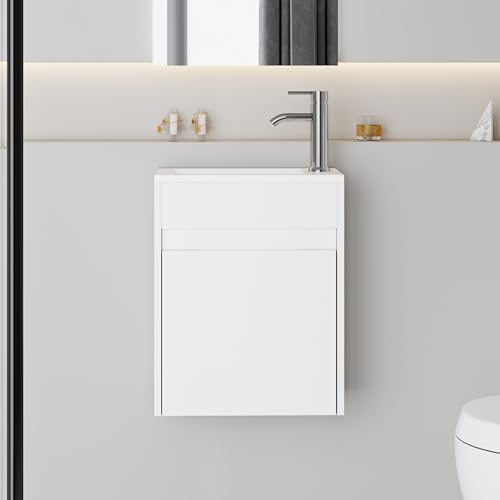
The narrowest vanity on the list is the eclife 16-inch floating vanity. Floating means wall-mounted: the cabinet hangs on the wall with open floor beneath it. The listing states a resin top, MDF / engineered wood for the cabinet, soft-close and a White finish. The title names a chrome faucet and a pop-up drain in the box.
Sixteen inches is a powder room size. It gives you a sink and a little storage where a pedestal sink might otherwise go.
That trade is the real question in a half bath. A pedestal sink has no storage at all, and its pipes show. A small vanity hides the pipes and gives you a shelf for the spare roll and the hand soap. What it asks for in return is a few inches of depth in front of the sink, so check the clear floor numbers below before you swap one for the other.
A wall-mounted vanity has one job a floor vanity doesn't: it carries its full weight on the wall. That means solid backing or studs where the mounting screws go, as the maker's instructions show. If you can't open the wall, choose a freestanding vanity instead.
18 inches, freestanding
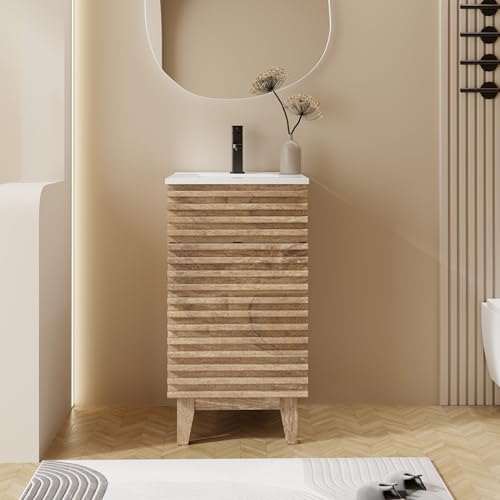
The second pick is the eclife 18-inch freestanding vanity in Light Walnut. The listing states a top with an undermount single sink, MDF / engineered wood and assembly required. The title names an adjustable shelf and includes a faucet and drain.
Two extra inches over the 16-inch vanity doesn't sound like much. In a half bath, it can be the difference between a sink you lean over and a sink you stand in front of. Measure it first, both ways, before you pick.
35 inches, integrated sink
The widest pick is a James Martin Vanities 35-inch vanity in Glossy White. The listing states a solid surface top with an integrated sink, and the title calls the sink stone composite. Integrated means the counter and bowl are one piece, so there's no seam between them to clean or reseal.
Thirty-five inches is the in-between width. In a 36-inch opening it leaves room for a filler strip, or for a wall that isn't square. The listing doesn't state the cabinet material, the mounting or the drawer layout, so get those from the maker's spec sheet before you order.
How to buy a budget bathroom vanity without regret
Measure the rough-in first
Here's my one firm opinion for this page: measure the drain and supply lines before you shop. The rough-in is where those pipes come out of the wall or floor. The vanity's back panel has to clear them, and the sink has to land over the drain. On a budget, a cabinet you have to cut or return costs you twice.
The National Kitchen & Bath Association's planning guideline adds two spacing numbers worth knowing. It recommends at least 20 inches from the center of a sink to a side wall or tall obstacle, and cites 15 inches as the code minimum. It also recommends 30 inches of clear floor in front of a sink, with 21 inches as the code minimum. Small vanities fit tight rooms, but those numbers still apply.
Count what's in the box
A cheap price on a base cabinet alone isn't the same as a cheap vanity. You still need a top, a sink, a faucet and a drain. Every pick here lists a sink, and the two eclife titles also name a faucet and a drain. That's an affordable vanity set in practice: one order, one box, no hunting for a top that fits.
If you're keeping your old top, the math changes. A cabinet that fits your existing top is the cheapest vanity of all. Measure the top's width and depth, and the sink bowl underneath, before you look.
Check the faucet you're getting
Some budget vanities include a faucet, and some titles call it water saving. If water use matters to you, look for the WaterSense label on the listing. The EPA says WaterSense labeled bathroom faucets and accessories use a maximum of 1.5 gallons per minute. That's against a federal standard of 2.2 gallons per minute. If the listing doesn't say WaterSense, don't assume it.
You can also keep the included faucet in the box and use one you already own, if the hole count on the top matches. One-hole and three-hole tops are not interchangeable without a cover plate.
Plan for assembly
Many budget vanities ship flat, and the listing says so with "assembly required". That's not a defect. It's a Saturday. Lay the parts out, count the hardware against the sheet, and read the instructions before you start, not after you've finished. Beau likes to help with the counting. His totals are creative. We count again together.
Treat MDF kindly
The two eclife picks list MDF or engineered wood for the cabinet. It's stable and smooth, which is why it takes paint well. What it doesn't like is water sitting on it. Run a bead of caulk where the top meets the wall, keep a towel on the counter edge, and fix any drip under the sink the week you find it.
Dell's take, from a man who has looked under a lot of sinks: "Buy the cheap vanity if it fits. Don't buy the cheap shutoff valves." He's right. If the old valves under your sink are stiff or crusted, the vanity swap is the moment to replace them, while everything is open. That's a plumbing call, and a plumber is the right person for it if you're not sure.
Affordable bathroom vanity sizes in our data
Most of the low tiers in our data are small vanities. That isn't a rule anyone set. It's just how vanities are built: a wider cabinet uses more material, and a wider top is a bigger slab. So if your wall is 30 or 36 inches, you'll see fewer budget options here than at 16 or 18, and above 36 almost none.
Two ways to stretch a budget at those widths:
- Base cabinet plus a stock top: sometimes cheaper than a full set, sometimes not, so compare the totals
- One size down: a 30-inch vanity in a 36-inch space leaves room at the side for a towel bar or a small shelf
For every width we track, see bathroom vanities. For the standard sizes and what fits where, see bathroom vanity sizes.
Who should skip this list
If your bathroom wall is wider than about 3 feet and you want the vanity to fill it, this list won't help much today, because its picks are narrow. Look at best bathroom vanities instead, sorted by width, or wait for a wider vanity to drop into the lower tiers.
And if your current vanity is sound and only looks tired, you may not need a new one at all. New hardware, a fresh coat of paint or a new top can change a bathroom for much less. I'd rather point you to a set of pulls than to a cabinet you didn't need.
How we picked
Every bathroom vanity in our data gets a price tier from its current Amazon US price at each check. This list keeps the vanities in the lowest tiers whose maker states the width, sorts them narrowest first, and allows two per brand. The specs in the notes come from the Amazon US listings as of 2026-10-31. Prices change on Amazon, so we never print them. A vanity that moves out of the lower tiers leaves the list on the next check, and one that moves in joins it.
Measure first. Then wait for the price, not the other way around.